Categories > Guides and Tips
Your Guide to Experiencing the Highland Games

- What are the Highland Games?
- Key Events at the Highland Games
- Caber Toss
- Hammer Throw
- Tug-of-War
- Stone Put
- Highland Dancing
- Bagpipe Competitions
- Clan Marching
- Scotland’s Most Famous Highland Games
- Braemar Gathering
- Cowal Highland Gathering
- Inverness Highland Games
- Lonach Highland Gathering & Games
- Aberfeldy Highland Games
My pop’s a big fan of the Highland Games. And I mean an enormous fan. We’d take trips here and there to watch. The first time I saw a caber toss, I was deludedly convinced I could do it too. Spoiler alert: I couldn’t.
Since the Highland Games were a big part of my childhood, I still make it a point to take my pops out to check them out, even if it takes me hours to drive there. I can already hear the pipes, smell the whisky, and feel the roar of the crowd. There’s truly nothing like it.
As a self-proclaimed expert, I’ll walk you through everything you need to know; what the Games are all about, where you can watch it, and even tips for first-time visitors. You won’t see any of that at the Olympics! So let’s dive right in.
What are the Highland Games?
Media credit: kilt_home
The Highland Games are a beloved Scottish tradition celebrated across the country and even abroad, typically from May to September.
It’s a joyful celebration of culture, clan pride, and community, and bringing people together for heavy athletic, musical performances, Highland dancing, and colourful pageantry. I’ll never forget the roars of the crowd, it’s pure Highland magic that feels both ancient and alive.
Apart from the games, there are also clan gatherings, artisan markets, and plenty of hearty Scottish food!
Fair warning, it might rain, but this is Scotland, after all, so what do you expect? A little rain definitely adds to the Highland charm and has never dampened the spirit of the games.
Key Events at the Highland Games
Caber Toss
Media Credit: thescottishgames
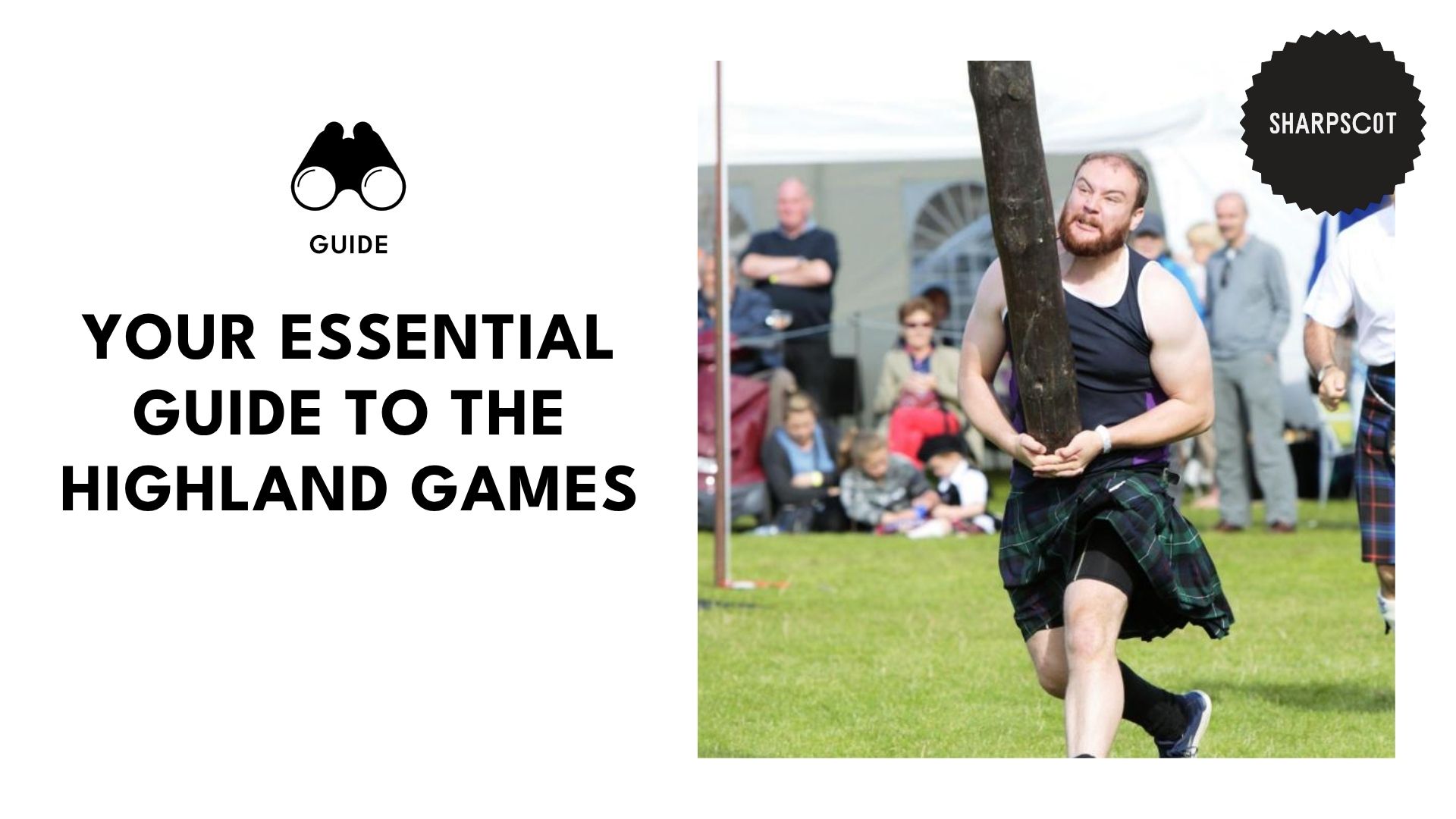
Allow me to save you from the technicalities. The caber toss is where athletes lift a giant log called a caber, run to build momentum, and then toss it into the air so that it flips and lands in a straight line. The more perfectly straight, the better the score.
Now, what’s super cool about this is that it’s a mental game. Heavies, or athletes, rely on raw Highland strength to throw a 5 to 6-metre-long (16 to 20 feet) log weighing up to 80 kg (175 pounds) to flip cleanly over to land at noon.
The first time I watched a caber toss, I remember feeling like this was something straight out of a folktale, incredibly ancient and almost mythical, which adds to the appeal, making it a fan favourite for a reason.
Hammer Throw
Media Credit: lvcameragirl
Now, just to clear things up first. This “hammer” isn’t the kind you’d find in a toolbox. It’s a long stick with a massive, heavy metal ball on the end – not the kind you’d use to hang a picture frame!
The hammer throw is a personal favourite and one of the wildest things you’ll see at the Highland Games. It’s very medieval-looking with many even donning special boots with spikes to get a better grip on the ground.
Then, they begin to spin the hammer around their head, building momentum, until the timing’s right to send it flying across the field. I can only imagine how much muscle it’ll take to chuck that thing!
Tug-of-War
Media Credit: embrohighlandgames
Now, here’s a game that’s exactly what it sounds like. Tug-of-war pits two teams against each other, both gripping onto a massive rope, each trying to pull the other team over the line. Sounds quite simple, right? Aye, but it’s absolutely brutal.
Players have to muster all of their strength, muscles bulging, faces red, heels dug deep into the ground, and pull hard enough to drag their opponents into the mud. And when it’s neck and neck? Man, that’s the most exhilarating part!
People screaming left and right, I tell you, I nearly lost my hearing! Though I didn’t notice it until after the game. It was that intense!
Stone Put
Media Credit: lvcameragirl
A classic, stone put is one of the truest tests of strength at the Highland Games. It’s similar to shot put where players need to throw it the farthest, but what makes stone put unique is that instead of a smooth metal ball players will use a rough, uneven chunk of stone.
There are also two ways the game is played. One is with a Braemar stone, which is 20 to 26 pounds and requires players to stay completely still. Imagine that! It’s raw power from a standing position, truly testing athletes’ strength, balance, and technique.
The second is with an open stone, which is a tad lighter at around 16 to 22 pounds. With this version of the game, athletes spin a bit or even run a little, allowing for more speed and technique to launch the stone further.
Highland Dancing
Media Credit: perth_highland_games
The music, the grace, the tradition, and Highland dancing are the highlights in every festival, and just as big of a deal as the heavy athletics. Judged competitively, it isn’t just about the pretty costumes.
Judges pay close attention to timing, precision, posture, footwork, stamina, and more. Many train for years, so don’t be surprised with performances full of effortless jumps, kicks, and spins.
Each type of Highland dance comes with a special bit of Scottish history. Ghillie Callum (Sword Dance) is done with two crossed swords while the Seann Triubhas is about kicking off trousers after the ban on kilts was lifted.
Bagpipe Competitions
Media Credit: perth_highland_games
What are the Highland Games without bagpipe competitions, right? If you ask me, it’s a refreshing break from all that tossing and pulling. And just like the other events, pipers are battling it out on stage.
Be sure to stick around to catch solo pipers. It’s just them and their pipes, pouring heart and soul into every note. It sounds incredibly haunting yet utterly powerful at the same time, hitting you right in the feels.
Then come the pipe bands, which, every time I watch it, feels like the kind of moment you’ve only ever seen in movies, only now it’s right in front of you. And just like the films, they’re loud and impressive as they march together and play in formation, perfectly synced.
Clan Marching
Media Credit: thescottishgames
One of the most moving parts of the Highland Games, at least for me, is the clan march. While it isn’t as exciting as the caber toss or as flashy as the Highland dancing, it gives you proper goosebumps seeing clans walk proudly under their family tartan.
Some carry old crests, badges passed down generations or even traditional weapons. It’s a quiet but powerful reminder of where we come from and how far those before us have come.
And even if you don’t belong to a clan yourself, it’s hard not to feel moved by watching it all unfold right before your eyes knowing that generations from now others might be marching in the very same footsteps.
Scotland’s Most Famous Highland Games
Braemar Gathering
Media Credit: braemargathering
Website
Location: The Princess Royal and Duke of Fife Memorial Park, Cairngorms Village, Braemar
Why It’s Famous: Regularly by the British Royal Family
Schedule: September
The Braemar Gathering isn’t just any Highland Games, it’s the Highland Games. It’s one of the oldest, tracing back 900 years ago, held at the heart of Cairngorms.
A Royal Family favourite, it’s been attended by the Royals since the days of Queen Victoria in the 1840s. If it’s been on their calendar for over a century, you know it’s not one to miss.
Like other Highland Games, it has all the classics like stone put and tug-of-war, with athletes from across Scotland competing. What makes this particular festival extra special is that it’s set on a world stage, so you’re in for a real treat.
But what brings the festival to life is the lively crowd it draws in, local food stalls selling traditional Scottish delicacies, and, let’s be honest, the chance to sample a dram (or two!) of proper Scottish whisky.
Local Tip:
- Book your tickets early as these sell out quickly, especially the seated grandstand area.
- Get there early to see the Royals arrive and watch the opening parade.
- Always have cash on hand as some stalls may not accept cards.
Cowal Highland Gathering
Media Credit: cowalgathering
Website
Location: Dunoon Stadium, Cowal Peninsula
Why It’s Famous: One of the largest Highland Games events drawing around 3,500 competitors and 23,000 spectators
Schedule: August
Beginning in 1984, the Cowal Highland Gathering is one of the largest celebrations of the Highland Games, so much so that it hosts the World Highland Dancing Championships, gathers elite heavies from around the world, and brings in over 23,000 attendees.
It’s also a big hit with the wee ones, especially, because of the Cowals Kids Tent, which has clown performances, magic shows, stunt cyclists, and even axe-throwing demos (don’t worry, they leave that one to the pros!).
Another highlight is the piping events, from grade-level piping bands to world-class championships. And honestly, even if you’re not into piping, it’s a feast for the ears and the energy is infectious enough that you’ll get caught up in the grandeur.
Local Tip:
- To enjoy hillside spots overlooking the stadium, arrive early.
- Don’t miss the finale to wrap up the Games, massed bands and Salute to the Chieftain, which happens on Saturday afternoon.
- Book your accommodations early if you’re planning on staying overnight.
Inverness Highland Games
Media Credit: invernesshighlandgames
Website
Location: Bught Park, Inverness
Why It’s Famous: One of the oldest Highland Games, dating back to 1822, and home to the one-of-a-kind Stonemason’s Challenge
Schedule: July
The Inverness Highland Games is where tradition runs deep, like 1822 deep. For many of the locals, it’s not just an annual event, it’s part of their family history.
It’s where their ancestors competed, piped, or even danced over two centuries ago. Hence, it’s no surprise that it also has the most interactive clan gatherings.
While it also has your usual heavy athletics, Inverness has something the other have done: the Stonemason’s Challenge. And when I said that it was rooted in history, I wasn’t kidding. The Stonemason’s Challenge has been here since 1882.
For a proper test of strength, heavies will need to lift a massive 252-pound (18-stone) boulder and hurl it over a 5-foot-high bar.
Local Tip:
- Check the event’s schedule online as the day’s packed with many activities happening at the same time. You can also grab an official programme to keep track of the events.
- Bring a blanket and a camping chair to best enjoy the events without sitting on the soggy grass.
- Don’t skip the Big Top ceilidh tent which is a blast in the evening with live bands, dancing, and more.
Lonach Highland Gathering & Games
Media Credit: quimianna
Website
Location: Bellabeg Park, Strathdon, Aberdeenshire
Why It’s Famous: Home to the iconic March of the Lonach Highlanders, a tradition dating back to 1823 to promote fellowship
Schedule: August
The Lonach Highland Gathering & Games is built on preserving culture and fostering fellowship. A testament to that is the March of the Lonach Highlanders, an unbroken tradition and one of the last ceremonial marches of its kind done today.
It’s done every morning of the Lonach Games, so you’ve got plenty of chances to watch over 200 men in full Highland dress carry Lochaber axes, pikes, and claymore march to traditional tunes over six miles until they return to Bellabeg Park.
Now, don’t be intimidated. They’re actually a very warm and close-knit community, even affectionately called “Scotland’s friendliest games”. No need to take it all too seriously, as it’s just as much about enjoying the people around you as the competitions.
Local Tip:
- The Highlander’s March starts at around 07:50, so arrive early so you can get a good roadside spot.
- Have cash on hand. Some stalls and tents may not accept cards.
- Dress warmly and pack waterproof footwear and layers.
Aberfeldy Highland Games
Media Credit: visitaberfeldytourismassoc
Website
Location: Aberfeldy, Perthshire
Why It’s Famous: Hosts a traditional agricultural show with livestock judging, parade of horses, mountain games, and pet shows.
Schedule: August
Agricultural fans who enjoy the small-town charm will love Aberfeldy’s take on the Highland Games. A longstanding tradition to honour their local farming roots and rural life, Aberfeldy hosts agricultural shows apart from the traditional classic games and festivities.
Just like winners of hill races and caber tosses, locals compete for “Best Highland Cow” or “Champion Clydesdale” which are enormous sources of pride for farmers whose livestock have been passed down through generations.
The wee ones, especially, will enjoy the terrier racing and fancy-dress horse classes. I know I did! Plus, you get to learn a little more about real-life Highland heritage and chat with the people who live and work on the land.
Visitor’s Tip:
- Pack sun cream and bug spray.
- Try the local bakes from the food tents
- Research on parking restrictions as some roads may be closed or have limited access while the Games are ongoing.